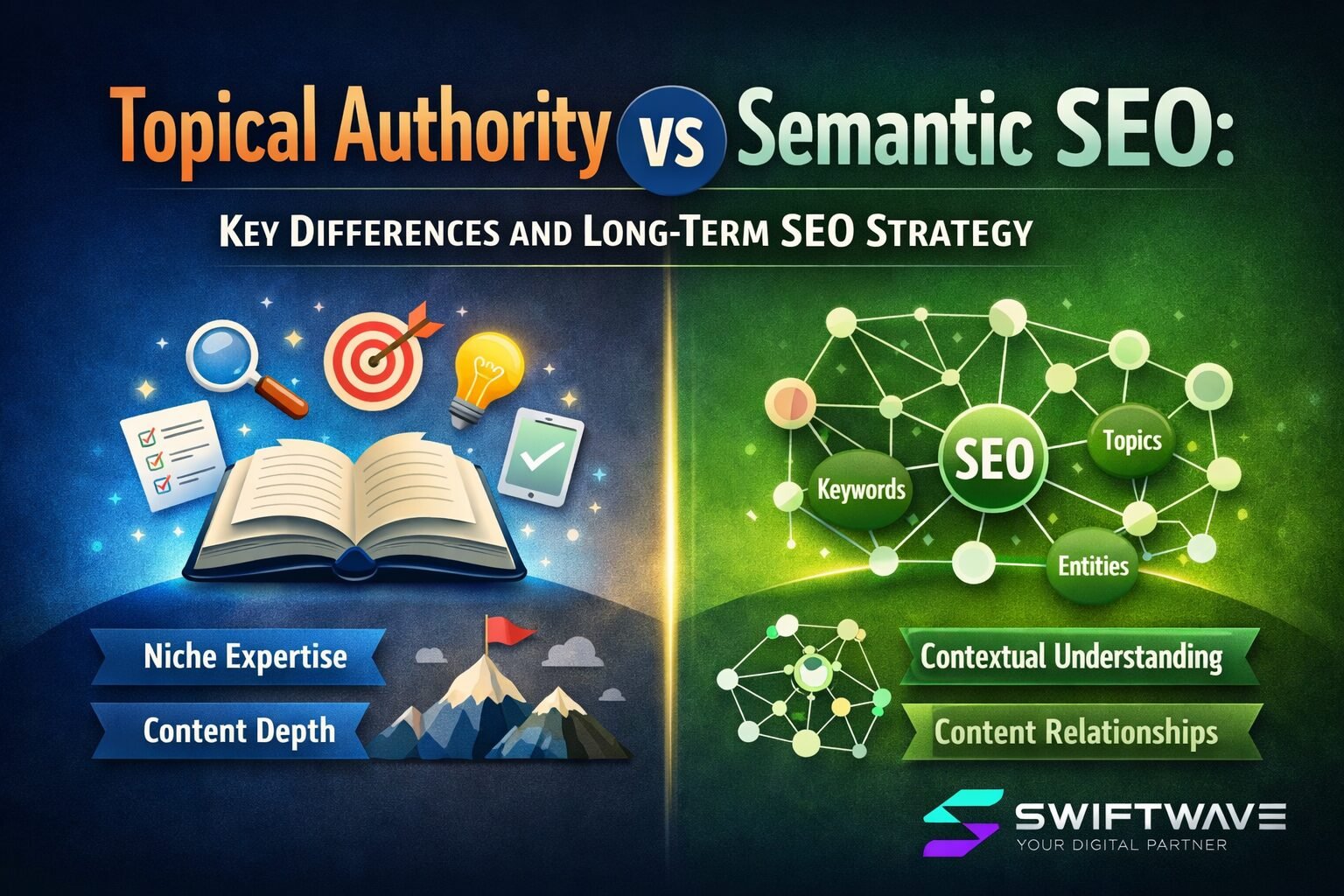
Topical Authority and Semantic SEO are two complementary strategies that shape modern search engine optimization. Topical Authority measures how comprehensively a website covers a subject across multiple pages, signaling domain-level expertise to search engines. Semantic SEO focuses on optimizing individual pages to communicate meaning, entity relationships, and contextual relevance, ensuring content aligns with user intent. Together, they create a structured ecosystem where topic clusters, internal linking, and semantically optimized content reinforce authority, relevance, and ranking potential.
Topical Authority relies on pillar pages supported by subtopic articles, providing breadth of coverage, while Semantic SEO organizes entities, attributes, and contextual connections within each page for depth. Search engines evaluate these strategies through topic coverage, internal links, entity recognition, content structure, and user engagement metrics. Pages optimized semantically benefit from improved intent matching, richer keyword coverage, and better algorithmic understanding.
Combining both approaches maximizes long-term SEO growth. Topical Authority strengthens domain credibility, while Semantic SEO ensures each page communicates meaning effectively. Websites that integrate clusters, semantic entity mapping, and structured content achieve higher ranking consistency, broader search visibility, and sustainable authority across related queries. This dual strategy supports scalable content creation, user experience, and resilience to algorithm updates, making it essential for modern SEO success.
What Is Topical Authority in SEO and Why Does It Matter?
Topical Authority in SEO is the measurable expertise a website demonstrates on a specific subject through comprehensive, interconnected content covering all major subtopics. Search engines evaluate topical authority by analyzing topic coverage, entity relationships, internal linking, and content depth. Platforms that systematically publish authoritative information across a subject domain gain stronger ranking signals. Swiftwave uses topical authority strategies to improve content relevance, domain trust, and search visibility across competitive keyword clusters.
Comprehensive Topic Coverage
Comprehensive topic coverage establishes topical authority by addressing all major subtopics within a subject area. Search engines analyze content clusters to determine whether a website explains a topic fully. Websites that publish multiple interlinked articles covering related queries signal expertise and reliability. Swiftwave structures topic clusters to strengthen domain-level authority and semantic relevance.
Entity and Context Relationships
Entity relationships strengthen topical authority by connecting related concepts, attributes, and terminology within content. Search engines use entity recognition systems to evaluate subject expertise. Content that references related entities, concepts, and contextual attributes demonstrates a deeper understanding of the topic domain. Swiftwave integrates entity-based optimization to reinforce semantic connections.
Internal Content Clustering
Internal content clustering organizes related articles under a central topic to signal expertise. Topic clusters include a primary pillar page supported by multiple detailed subtopic pages. Strategic internal linking distributes authority and improves contextual relevance. Swiftwave uses structured internal linking to strengthen topical authority signals across the website.
Search Engine Trust Signals
Search engines interpret topical authority as a trust signal that indicates subject expertise. Websites that consistently publish high-quality information on a topic receive stronger ranking opportunities. Content depth, accuracy, and contextual alignment influence algorithmic evaluation of expertise. Swiftwave focuses on expertise-driven content architecture to strengthen trust signals.
Improved Ranking Potential
Topical authority increases ranking potential across large keyword groups within the same subject. A website that demonstrates expertise across related queries can rank for hundreds of long-tail variations. Search engines prefer authoritative sources when selecting content for high-competition queries. Swiftwave uses topical authority frameworks to expand organic keyword coverage.
User Intent Satisfaction
Topical authority improves user intent satisfaction by delivering complete information across a subject. Visitors can access definitions, comparisons, guides, and solutions within the same domain. Comprehensive coverage increases dwell time, engagement, and repeat visits. Swiftwave designs topic ecosystems that address informational, commercial, and navigational intent.
Long-Term SEO Growth
Topical authority supports sustainable SEO growth by building domain expertise over time. Websites that continuously expand their topic clusters strengthen search visibility and organic traffic stability. Search engines prioritize consistent subject expertise rather than isolated keyword pages. Swiftwave applies topical authority frameworks to create scalable organic growth strategies.
What Is Semantic SEO and How Does It Improve Search Understanding?
Semantic SEO is an optimization method that improves search understanding by structuring content around entities, context, and relationships rather than isolated keywords. Search engines analyze semantic signals such as entity connections, topical relevance, and contextual depth to interpret meaning. Content built with semantic SEO provides clear topic explanations and related concept coverage. Swiftwave implements semantic SEO to help search engines understand subject context, improve relevance matching, and increase visibility across multiple query variations.
Entity-Based Content Optimization
Entity-based optimization improves semantic SEO by identifying key concepts and their attributes within a topic. Search engines use Named Entity Recognition systems to interpret relationships between entities such as brands, technologies, and concepts. Content that clearly defines entities strengthens contextual clarity and search understanding. Swiftwave structures content around entity relationships to reinforce semantic relevance.
Contextual Topic Coverage
Contextual topic coverage strengthens semantic SEO by explaining a subject through connected ideas and attributes. Search engines evaluate whether related terms and supporting concepts appear naturally within the content. Comprehensive context signals deeper understanding of the topic. Swiftwave builds semantic content that integrates primary terms, related attributes, and supporting explanations.
Query Intent Matching
Semantic SEO improves query intent matching by aligning content with the meaning behind search queries. Search algorithms analyze intent categories such as informational, transactional, and navigational queries. Content that answers intent directly receives stronger relevance signals. Swiftwave optimizes semantic structures to ensure accurate intent satisfaction across search queries.
Natural Language Processing Integration
Semantic SEO aligns with Natural Language Processing systems used by modern search engines. NLP algorithms evaluate grammar structure, topic relationships, and contextual coherence to interpret content meaning. Clear sentence structures and topic consistency improve algorithmic comprehension. Swiftwave develops content frameworks that match NLP interpretation patterns.
Improved Content Relevance
Semantic SEO increases content relevance by connecting primary topics with supporting subtopics and attributes. Search engines compare document context with query language to determine relevance probability. Rich contextual signals strengthen ranking opportunities. Swiftwave enhances relevance through semantic topic mapping and structured content hierarchies.
Keyword Variation Coverage
Semantic SEO enables content to rank for multiple keyword variations without repeating exact phrases. Search engines interpret synonyms, related queries, and phrase variations through contextual signals. Content optimized semantically captures broader search demand. Swiftwave applies semantic modeling to expand organic keyword reach.
What Is the Core Difference Between Topical Authority and Semantic SEO?
The core difference between Topical Authority and Semantic SEO is scope and function. Topical Authority measures how comprehensively a website covers a subject across multiple pages, while Semantic SEO optimizes how individual content pieces communicate meaning, entities, and context to search engines. Topical Authority focuses on topic coverage, whereas Semantic SEO focuses on content understanding.
Scope of Optimization
Topical Authority operates at the website or domain level, while Semantic SEO operates at the page or document level. Topical authority evaluates how many related topics a site covers within a niche. Semantic SEO improves the contextual meaning of a single page through entity relationships, structured headings, and semantic clarity.
Content Structure
Topical Authority relies on topic clusters, while Semantic SEO relies on contextual document structure. Topic clusters include pillar pages supported by multiple subtopic articles. Semantic SEO organizes entities, attributes, and related concepts within one article to strengthen contextual relevance.
Search Engine Interpretation
Topical Authority signals subject expertise, while Semantic SEO improves algorithmic understanding of content meaning. Search engines evaluate topical authority through domain-wide topic coverage and internal linking. Semantic SEO helps algorithms interpret entity relationships and contextual connections.
Ranking Influence
Topical Authority increases ranking potential across large keyword groups, while Semantic SEO improves ranking precision for specific queries. Websites with strong topical authority can rank for hundreds of related keywords. Semantically optimized pages match user queries with higher contextual accuracy.
Content Creation Strategy
Topical Authority requires publishing multiple related articles, while Semantic SEO requires deeper contextual optimization within each article. Topic expansion strengthens authority signals, while semantic structuring improves clarity and search intent alignment.
Internal Linking Role
Topical Authority depends on internal links connecting topic clusters, while Semantic SEO depends on contextual word relationships within the content. Internal links distribute authority between pages, while semantic signals connect entities, attributes, and concepts.
How Do Search Engines Use Topical Authority to Rank Websites?
Search engines use Topical Authority to rank websites by evaluating how comprehensively a domain covers a subject through interconnected, high-quality content. Algorithms analyze topic clusters, entity relationships, internal links, and contextual depth to determine expertise. Websites that publish consistent, well-structured information across related queries demonstrate stronger authority signals and gain higher ranking potential within the same topic domain.
Topic Coverage Evaluation
Search engines evaluate topical authority by measuring how many related subtopics a website covers within a subject area. Domains that publish content across definitions, guides, comparisons, and use cases demonstrate broader expertise. Comprehensive topic coverage signals that the website provides complete information for users searching within the topic.
Internal Linking Analysis
Internal linking helps search engines identify relationships between pages within a topic cluster. Connected articles signal a structured knowledge network that supports a central topic. Clear internal linking strengthens authority signals and helps algorithms understand topic hierarchy and relevance.
Entity Relationship Detection
Search engines analyze entity relationships to verify subject expertise. Named Entity Recognition systems identify concepts, attributes, and related terms within content. Pages that consistently reference relevant entities demonstrate deeper topical knowledge.
Content Depth and Quality Signals
Content depth strengthens topical authority by providing detailed explanations, data points, and contextual coverage. Algorithms evaluate whether an article explains a subject thoroughly rather than superficially. High informational depth improves expertise signals and ranking potential.
Query Coverage Across Variations
Topical authority improves ranking opportunities across multiple keyword variations related to the same subject. Search engines prefer authoritative sources when selecting results for long-tail queries, synonyms, and related search intents.
User Engagement Signals
User behavior signals support topical authority evaluation. Higher dwell time, lower bounce rates, and repeated visits indicate that users find the content valuable. Engagement metrics reinforce algorithmic confidence in the website’s subject expertise.
How Does Semantic SEO Help Search Engines Understand Context and Intent?
Semantic SEO helps search engines understand context and intent by organizing content around entities, related concepts, and meaningful relationships rather than isolated keywords. Modern algorithms analyze semantic signals such as topic relevance, entity attributes, and sentence structure to interpret meaning. Content built with semantic SEO explains a subject through connected information, allowing search engines to match user queries with the most relevant and contextually accurate results.
Entity Recognition and Relationships
Semantic SEO improves context understanding through entity recognition and entity relationships. Search engines identify entities such as concepts, technologies, brands, and categories within content. Clear references to related entities help algorithms determine how topics connect within a knowledge graph.
Contextual Topic Signals
Semantic SEO strengthens contextual signals by integrating related terms and attributes within the same document. Search engines analyze whether supporting concepts appear naturally alongside the main topic. Strong contextual coverage improves topic clarity and relevance evaluation.
Search Intent Alignment
Semantic SEO improves search intent matching by aligning content with the meaning behind queries. Search engines classify queries into informational, navigational, and transactional intent categories. Content that answers the underlying intent receives stronger relevance signals.
Natural Language Processing Interpretation
Semantic SEO aligns with Natural Language Processing systems that interpret sentence meaning and relationships between words. NLP algorithms analyze grammar patterns, contextual terms, and semantic proximity to determine topic relevance. Structured content improves algorithmic comprehension.
Synonyms and Query Variations
Semantic SEO enables search engines to understand synonyms and related keyword variations. Algorithms evaluate semantic similarity between words rather than exact keyword repetition. Content optimized semantically can rank for multiple related search phrases.
Structured Content Hierarchy
Semantic SEO improves understanding through structured headings and logical content hierarchy. Clear H1, H2, and H3 structures create a linear contextual vector from the beginning to the end of the document. Search engines interpret structured documents more efficiently.
How Do Topic Clusters Help Build Topical Authority?
Topic clusters help build Topical Authority by organizing content around a central pillar page supported by multiple related subtopic articles. Search engines evaluate the cluster as a comprehensive coverage of a subject, reinforcing domain expertise and relevance. Structured clusters improve internal linking, semantic connections, and user navigation, signaling authoritative knowledge within a topic area.
Pillar Page as Core Topic
The pillar page defines the main subject and links to supporting subtopics. It provides a high-level overview while directing users to in-depth content. Search engines treat the pillar page as the authoritative entry point for the topic.
Supporting Subtopic Articles
Subtopic pages cover specific aspects, questions, or use cases related to the main topic. Each article reinforces the pillar page by providing detailed explanations and context. Together, they create comprehensive content coverage.
Strategic Internal Linking
Internal links between pillar and subtopic pages distribute authority and context signals. Search engines follow these links to understand topic relationships and measure expertise across the website.
Semantic Connectivity
Topic clusters strengthen semantic connections by grouping related entities, attributes, and concepts. Consistent terminology and contextual relevance across cluster pages improve search engine comprehension of subject depth.
Improved User Navigation
Clusters enhance user experience by providing a clear content pathway. Visitors can explore related subtopics efficiently, increasing dwell time and engagement, which indirectly reinforces authority signals.
Enhanced Ranking Potential
Topic clusters increase ranking opportunities across multiple keyword variations. Search engines recognize the comprehensive coverage and may rank cluster pages for related queries, long-tail keywords, and semantic variations.
How Do Entities and Contextual Relationships Power Semantic SEO?
Entities and contextual relationships power Semantic SEO by providing search engines with clear signals about topic meaning, relevance, and connections. Entities represent specific concepts, brands, or objects, while contextual relationships define how these entities interact. Together, they allow algorithms to interpret content beyond keywords, matching user intent with higher precision.
Named Entity Recognition
Search engines use Named Entity Recognition to identify key concepts within content. Entities such as products, technologies, locations, or people signal the subject domain. Accurate entity identification improves semantic clarity and relevance.
Relationships Between Entities
Contextual relationships define how entities connect within a topic. For example, a product entity may relate to benefits, features, and comparisons. Linking these relationships in content helps search engines understand topic structure.
Synonyms and Semantic Variations
Semantic SEO uses synonyms and related terms to reinforce entity connections. Search engines interpret these variations as part of the same conceptual topic, expanding ranking potential across multiple query forms.
Content Context and Relevance
Contextual relationships provide depth by showing how entities interact within the subject. Clear connections between entities, attributes, and supporting concepts strengthen content relevance for both users and algorithms.
Knowledge Graph Alignment
Entities and relationships integrate with knowledge graph structures used by search engines. Well-defined entity-context networks improve indexing accuracy and help content appear in rich results, snippets, or knowledge panels.
Algorithmic Comprehension
Structured entity relationships enhance search engine comprehension of content meaning. Algorithms can evaluate expertise, topic completeness, and user intent alignment more effectively when entities and context are clearly defined.
Can a Website Build Topical Authority Without Semantic SEO?
A website can build Topical Authority without full Semantic SEO, but growth is slower and less precise. Covering all relevant subtopics and publishing comprehensive, interconnected content establishes authority signals. However, without semantic structuring, search engines may struggle to fully understand entity relationships, context, and user intent, limiting ranking potential.
Comprehensive Content Coverage
Publishing multiple articles across a topic niche contributes to authority. Search engines recognize breadth of coverage even if semantic signals are minimal. Depth and completeness of information remain key.
Internal Linking Benefits
Internal links between related pages still strengthen topic clusters. Linking subtopics to a central pillar page creates a content network that search engines can follow to gauge subject expertise.
Limitations in Context Understanding
Without semantic SEO, search engines may misinterpret relationships between concepts. Keyword-focused content may fail to capture nuances, synonyms, and entity connections, reducing relevance for certain queries.
Reduced Query Variation Ranking
Topical Authority alone may not rank pages for all long-tail or semantically related searches. Pages might perform well for exact match keywords but miss opportunities for broader intent coverage.
User Experience Signals
Even without semantic optimization, user engagement can reinforce authority. High dwell time, low bounce rates, and repeated visits indicate value, though semantic clarity amplifies these signals.
Long-Term Growth Considerations
Combining Topical Authority with Semantic SEO maximizes growth potential. Semantic structuring ensures content is understood by search engines, improving accuracy, ranking consistency, and intent satisfaction.
How Should Businesses Combine Topical Authority and Semantic SEO in a Modern Strategy?
Businesses should combine Topical Authority and Semantic SEO by using topic clusters for comprehensive coverage while optimizing individual pages for context, entities, and user intent. Topical Authority ensures domain-level expertise across subtopics, while Semantic SEO clarifies meaning and relationships within each page, creating a robust framework for ranking and intent fulfillment.
Establish Core Pillar Topics
Identify key subject areas as pillar topics to anchor content clusters. Each pillar page addresses a broad theme and links to multiple subtopic pages. This structure signals expertise and reinforces domain authority.
Optimize Individual Pages Semantically
Each subtopic page should integrate entities, contextual relationships, and semantic connections. Semantic structuring ensures search engines understand content meaning, attributes, and user intent. Clear headings, definitions, and related terms enhance relevance.
Strategic Internal Linking
Link subtopic articles back to their pillar pages and to related subtopics. Internal linking distributes authority, strengthens topic coverage, and allows search engines to map relationships across the content network.
Cover Related Keywords and Queries
Use semantic SEO to naturally include synonyms, related terms, and long-tail queries within cluster content. This approach improves intent matching and expands ranking opportunities across the topic ecosystem.
Monitor and Expand Clusters
Regularly analyze search performance and user engagement to identify content gaps. Adding new subtopics or refining semantic connections enhances both topical authority and algorithmic understanding over time.
Align with User Intent
Ensure content addresses informational, transactional, and navigational queries. Semantic SEO helps pages satisfy intent, while topic clusters provide complete coverage, creating a cohesive experience for users and search engines.
Which Approach Drives Better Long-Term SEO Growth?
Combining Topical Authority with Semantic SEO drives the strongest long-term SEO growth. Topical Authority establishes domain-wide expertise across a subject, while Semantic SEO ensures each page communicates meaning, entities, and context effectively. Together, they improve ranking consistency, user intent satisfaction, and visibility across related search queries.
Sustained Domain Expertise
Topical Authority signals comprehensive subject knowledge to search engines. Domains with broad, interconnected content gain trust and are more likely to rank for new queries within the same topic area.
Enhanced Page-Level Understanding
Semantic SEO improves how individual pages are interpreted by search engines. Entity relationships, contextual relevance, and structured content ensure accurate matching with user intent, enhancing ranking precision.
Broader Keyword Coverage
The combined approach allows coverage of primary, long-tail, and semantically related keywords. Pages optimized semantically within clusters rank for multiple variations, capturing larger search demand.
Improved User Engagement
Content that integrates authority and semantic clarity enhances user experience. Clear structure, contextual depth, and relevant coverage increase dwell time, reduce bounce rates, and reinforce algorithmic trust.
Resilience to Algorithm Updates
Websites combining both strategies are less vulnerable to search algorithm changes. Topical depth and semantic signals maintain relevance even if keyword-based ranking factors shift.
Scalable SEO Growth
The integration supports scalable content strategies. New subtopics can be added to clusters, while semantic optimization ensures search engines understand the evolving content ecosystem.
Summing Up
Combining Topical Authority and Semantic SEO creates a powerful framework for long-term SEO success. Topical Authority establishes comprehensive domain-level expertise by covering multiple related subtopics, while Semantic SEO ensures each page clearly communicates meaning, entities, and contextual relevance to search engines.
Together, these strategies improve ranking potential, user intent alignment, and keyword coverage. Topic clusters, internal linking, and semantically structured content reinforce authority signals, while entity relationships and contextual depth enhance algorithmic comprehension.
Websites that integrate both approaches benefit from sustainable growth, broader search visibility, and stronger domain credibility. Leveraging comprehensive topic coverage alongside semantic optimization allows content to rank consistently across primary, long-tail, and semantically related queries, ensuring a scalable and resilient SEO strategy for the modern digital landscape.