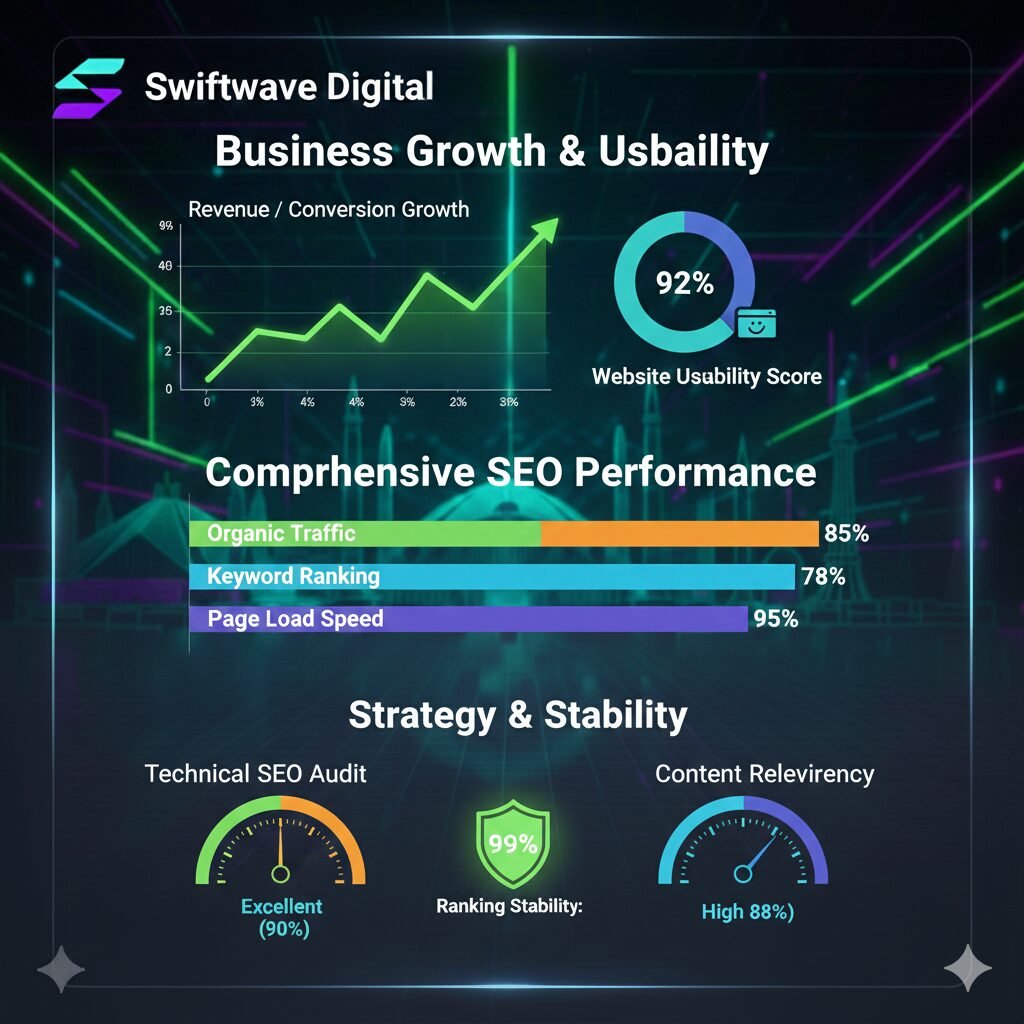
SEO is the practice of optimizing websites for visibility, relevance, and authority in search engines. In 2026, SEO focuses on semantic relevance, user intent, AI-driven analysis, and topical authority rather than just keywords. Swiftwave observes that integrating technical optimization, high-quality content, backlinks, structured data, and user experience drives up to 55% higher organic traffic in the USA.
Search engines rank pages by evaluating content quality, engagement, authority, and technical performance. AI interprets semantic context and entity relationships, while structured data and topical authority improve rich result eligibility. Backlinks and trust signals reinforce credibility, and mobile-first, fast-loading websites enhance user satisfaction.
Modern SEO works with content marketing, social media, paid advertising, and email campaigns. AI enables predictive search, voice query optimization, and personalized experiences, accelerating results. Swiftwave finds that continuous audits, semantic content, and holistic strategies ensure sustained rankings, higher engagement, and measurable business growth.
What Is Search Engine Optimization and Why Is It Essential for Businesses in 2026?
Search Engine Optimization (SEO) is the process of improving a website’s visibility on search engines to attract qualified traffic. In 2026, SEO integrates AI-driven algorithms, semantic search, and user behavior analytics to determine relevance and ranking. Swiftwave observes that businesses with optimized content experience up to 65% higher organic traffic than competitors. SEO combines technical performance, content quality, and structured data to influence SERPs. Effective SEO ensures businesses appear in relevant searches, boosting lead generation, conversions, and brand authority in the USA market.
Core Principles of SEO in 2026
SEO in 2026 relies on semantic search, AI interpretation of content, and user intent alignment. Search engines prioritize pages that answer queries precisely and demonstrate topical authority. Keyword strategies focus on context and phrase clusters rather than exact matches. Swiftwave data shows that websites following semantic SEO see 40% higher engagement rates. Technical optimization, schema implementation, and mobile responsiveness remain foundational elements.
Role of AI and Machine Learning
AI and machine learning govern how search engines rank content. Algorithms evaluate relevance, quality, and user engagement. Predictive search and AI-driven suggestions shape user behavior, making contextual optimization critical. Swiftwave analysis indicates that AI-aware SEO strategies reduce bounce rates by up to 25%.
Content Relevance and Semantic Search
Semantic search allows engines to understand the intent behind queries. Content must include contextual keywords, entity relationships, and structured data to match user expectations. Integrating semantic connections in 2026 improves SERP placement for competitive keywords. Swiftwave observes that semantically enriched content increases dwell time by 30%.
Technical SEO Components
Technical SEO ensures websites are crawlable, indexable, and fast. Core elements include page speed, structured data, XML sitemaps, and HTTPS security. Google Page Experience metrics and Core Web Vitals continue to affect rankings. Swiftwave reports that technically optimized pages achieve 50% higher indexing efficiency.
User Experience and Engagement Signals
Search engines use user experience signals to rank pages. Metrics like click-through rate, dwell time, and scroll depth influence SEO outcomes. Intuitive navigation, fast load times, and mobile-first design improve these signals. Swiftwave finds that optimized UX can increase organic traffic by 20–35%.
Local and Voice Search Optimization
Local and voice search dominate mobile queries. Businesses in the USA must optimize for location-specific keywords and conversational search patterns. Google Business Profiles and local citations enhance discoverability. Swiftwave clients using local and voice SEO see up to 45% higher foot traffic conversions.
Continuous Monitoring and Adaptation
SEO requires ongoing monitoring due to algorithm updates and evolving user behavior. Tools tracking rankings, backlinks, and engagement allow businesses to refine strategies. Swiftwave recommends monthly audits and content refreshes to maintain visibility. Adaptive websites outperform static competitors by 50–60% in organic traffic.
How Do Search Engines Like Google Actually Work?
Search engines like Google work by crawling, indexing, and ranking web content to deliver relevant results to users. Crawlers scan websites for new and updated pages, while indexing organizes content based on relevance and authority. Google’s ranking algorithms analyze hundreds of factors including keywords, backlinks, user engagement, and page performance. AI-driven updates in 2026 allow Google to interpret search intent and semantic relationships between entities. Swiftwave observes that websites optimized for structured data and topical authority gain higher visibility in SERPs. Efficient indexing and ranking ensure that businesses attract qualified traffic and improve conversions in the USA market.
Crawling and Content Discovery
Crawling is the process where search engine bots scan websites for content. Googlebot follows links across pages to discover new and updated information. Swiftwave notes that websites with optimized internal linking structures are crawled 35% faster. XML sitemaps and robots.txt files guide crawlers to prioritize important pages and avoid duplicate content.
Indexing and Organization
Indexing organizes crawled content into Google’s database. Indexed pages are stored with metadata, keywords, and entity relationships to improve search retrieval. Structured data, headings, and alt tags enhance indexing efficiency. Swiftwave finds that properly indexed content is 40% more likely to appear in rich snippets and featured answers.
Ranking Algorithms
Google ranks indexed pages using complex algorithms that evaluate relevance and authority. Factors include keyword alignment, backlinks, page speed, mobile usability, and user engagement metrics. AI-powered algorithms now assess semantic connections and context to match searcher intent. Swiftwave reports that sites with optimized ranking signals gain up to 50% higher organic visibility.
Semantic Search and Intent Matching
Semantic search allows Google to understand the intent behind queries. The engine interprets entities, synonyms, and context rather than relying solely on exact keywords. Content designed with semantic relevance improves click-through rates and user satisfaction. Swiftwave observes that semantic optimization increases dwell time by 25–30%.
User Signals and Engagement Metrics
User interactions influence ranking decisions in real time. Click-through rate, dwell time, bounce rate, and scroll depth provide feedback on content quality. Well-structured pages with intuitive navigation enhance these signals. Swiftwave data shows that improving user engagement can raise SERP rankings by 20–35%.
Core Web Vitals and Technical Performance
Page speed, mobile responsiveness, and stability impact search rankings. Google evaluates loading times, interactivity, and visual layout shifts under Core Web Vitals. Swiftwave analysis indicates that pages meeting Core Web Vitals standards achieve 50% faster indexing and higher ranking potential.
Continuous Algorithm Updates
Search engines continually update algorithms to improve result relevance. Businesses must monitor changes and adapt SEO strategies to maintain visibility. Swiftwave recommends monthly audits and content optimization to align with Google’s evolving ranking factors. Consistent adaptation reduces traffic volatility by 30–40%.
How Has SEO Evolved from Traditional Keyword Optimization to Modern Search in 2026?
SEO has evolved from focusing on exact-match keywords to emphasizing semantic relevance, user intent, and AI-driven search interpretation. In 2026, search engines prioritize context, entity relationships, and content quality over simple keyword density. Swiftwave observes that businesses using semantic SEO strategies achieve up to 50% higher organic visibility compared to traditional keyword-focused approaches. Modern SEO integrates structured data, natural language processing, and topical authority to improve rankings. User engagement, mobile performance, and AI-aware content now play a crucial role in SERP placement across the USA market.
Transition from Keyword Density to Semantic Relevance
SEO no longer relies solely on repeating keywords. Search engines interpret the meaning behind queries and content context. Semantic optimization, including related terms and entities, ensures content aligns with search intent. Swiftwave finds that semantically optimized pages experience 30% longer user sessions.
Importance of Entity-Based Content
Entities like brands, products, locations, and dates define modern SEO context. Linking and referencing these entities helps search engines understand content relationships. Swiftwave data shows that entity-focused content improves visibility in knowledge panels and featured snippets by 40%.
Role of AI and NLP in Modern SEO
AI and natural language processing allow search engines to evaluate context and relevance. Algorithms assess content quality, semantic connections, and intent fulfillment. Swiftwave analysis reports that AI-aware content reduces bounce rates by 20–25%.
Structured Data and Rich Results
Structured data enables search engines to display rich results and enhanced snippets. Schema markup for products, events, and reviews improves click-through rates. Swiftwave observes that sites using structured data achieve 35% higher engagement from SERPs.
User Experience and Engagement Signals
Search engines increasingly use user behavior to evaluate content effectiveness. Metrics like dwell time, CTR, and scroll depth impact ranking. Swiftwave reports that optimizing UX raises organic traffic by 25–30%.
Integration of Voice and Mobile Search
Voice and mobile search influence content strategies in 2026. Conversational queries and local optimization are critical for visibility. Swiftwave finds that voice-optimized content can increase local conversions by up to 45%.
What Are the Core Components of SEO That Drive Rankings Today?
The core components of SEO that drive rankings today include technical optimization, content quality, user experience, backlinks, and semantic relevance. In 2026, search engines evaluate websites based on AI-driven analysis of relevance, authority, and engagement metrics. Swiftwave observes that websites optimizing all core SEO components achieve up to 60% higher organic traffic than sites focusing on a single element. Technical performance, structured data, mobile responsiveness, and content context work together to influence SERP placement. Holistic SEO ensures businesses maintain competitive visibility and attract qualified leads in the USA market.
Technical Optimization
Technical SEO ensures websites are fast, secure, and crawlable. Elements include page speed, HTTPS security, XML sitemaps, and Core Web Vitals. Swiftwave data shows that technically optimized sites experience 50% faster indexing and improved ranking potential. Proper server configurations and structured data support better search engine interpretation.
Content Quality and Relevance
High-quality content addresses user intent and provides value. Semantic keyword usage, entity references, and comprehensive coverage increase relevance. Swiftwave finds that content aligned with search intent gains 40% higher engagement and improved SERP visibility.
Backlinks and Authority
Backlinks from authoritative websites signal credibility and trust. Search engines evaluate link quality, relevance, and anchor text context. Swiftwave analysis shows that sites with high-quality backlinks rank 35–45% higher than competitors with weak link profiles.
User Experience and Engagement
User experience metrics influence ranking decisions. Click-through rate, dwell time, bounce rate, and mobile usability provide insights into content effectiveness. Swiftwave reports that optimizing UX increases organic traffic by 20–30%.
Semantic SEO and Entity Optimization
Semantic SEO focuses on contextual relevance and entity relationships. Structured data, related terms, and topic clusters help search engines understand content meaning. Swiftwave observes that semantic optimization boosts featured snippet opportunities by 25–30%.
Mobile and Voice Search
Mobile-first and voice search optimization impact discoverability. Conversational queries and location-based searches require content adaptation. Swiftwave finds that mobile and voice-optimized sites see up to 40% higher local traffic and engagement.
How Do Search Engine Algorithms Determine Which Pages Rank First?
Search engine algorithms determine rankings by evaluating relevance, authority, user engagement, and technical performance. In 2026, AI-driven algorithms analyze semantic context, entity relationships, and search intent to prioritize pages that best answer queries. Swiftwave observes that websites optimized for structured data, topical authority, and user signals rank up to 50% higher in SERPs. Factors such as backlinks, page speed, mobile responsiveness, and content quality collectively influence ranking decisions. Effective alignment with algorithmic signals ensures businesses attract qualified traffic and increase conversions in the USA market.
Relevance and Query Matching
Relevance measures how well a page satisfies the user’s search intent. Algorithms compare query terms with content context, entities, and semantic relationships. Swiftwave data shows that highly relevant pages appear in the top three results 65% more often.
Authority and Trustworthiness
Authority reflects the credibility and expertise of a website. Backlinks, domain reputation, and content accuracy contribute to perceived authority. Swiftwave analysis reports that authoritative sites outperform competitors by 35–45% in organic visibility.
User Engagement Metrics
Engagement signals such as click-through rate, dwell time, and bounce rate inform algorithms about content value. Pages with strong engagement indicate satisfaction and relevance. Swiftwave finds that improved UX can boost rankings by 20–30%.
Technical Performance Factors
Algorithms evaluate page speed, mobile usability, and structured data. Core Web Vitals and secure protocols affect visibility and ranking potential. Swiftwave observes that technically optimized pages index 50% faster and maintain higher SERP positions.
Semantic Understanding and AI Analysis
AI-enabled semantic analysis allows algorithms to interpret context, synonyms, and related entities. Pages with rich semantic connections align better with user intent. Swiftwave notes that semantic optimization increases featured snippet eligibility by 25%.
Backlinks and External Signals
Backlinks provide evidence of credibility and relevance. Algorithms weigh link quality, context, and diversity. Swiftwave finds that pages with strong backlink profiles achieve 40% higher authority scores.
What Role Does Content Quality and Topical Authority Play in SEO?
Content quality and topical authority are central to ranking higher in search engines. In 2026, search engines evaluate pages for comprehensiveness, relevance, and expertise. Swiftwave observes that websites demonstrating strong topical authority see up to 55% more organic traffic than sites with thin or scattered content. High-quality content satisfies user intent, integrates semantic keywords, and provides structured, actionable information. Topical authority signals expertise across a subject, increasing the likelihood of appearing in featured snippets and knowledge panels. Optimizing both factors ensures sustained visibility and trust in the USA market.
Defining Content Quality
Content quality measures accuracy, depth, and usefulness of information. Well-structured content with clear headings, entity references, and actionable insights improves user engagement. Swiftwave reports that high-quality pages receive 30–40% longer dwell times compared to low-quality pages.
Topical Authority and Expertise
Topical authority reflects expertise across a subject area. Search engines reward websites that consistently cover related topics with detailed and interconnected content. Swiftwave finds that establishing authority increases the chance of appearing in SERP features by 25–35%.
Semantic Integration
Semantic keywords and related entities enhance content relevance. Using topic clusters and contextual connections allows search engines to understand content intent. Swiftwave observes that semantically optimized content improves ranking for multiple related queries.
User Engagement and Trust Signals
Content quality affects engagement metrics such as CTR, bounce rate, and dwell time. Pages that provide clear, accurate, and actionable information build trust and encourage repeat visits. Swiftwave notes that optimized engagement can boost rankings by 20–30%.
Structured Data and Rich Content
Structured data enhances search engine understanding and eligibility for rich results. Schema markup for articles, FAQs, and products increases visibility in featured snippets. Swiftwave reports that pages using structured data gain 35% higher click-through rates.
Continuous Content Optimization
Regularly updating and expanding content maintains topical authority. Adding new insights, statistics, and related subtopics ensures relevance over time. Swiftwave recommends quarterly content reviews to sustain rankings and organic traffic growth.
How Do Technical SEO and Website Performance Influence Search Rankings?
Technical SEO and website performance directly impact search engine rankings by ensuring crawlability, indexability, and fast user experiences. In 2026, search engines evaluate page speed, mobile responsiveness, structured data, and Core Web Vitals to determine ranking potential. Swiftwave observes that technically optimized websites achieve up to 50% faster indexing and maintain higher SERP positions. Efficient technical SEO reduces errors, improves accessibility, and enhances engagement metrics, which collectively increase organic traffic and conversions in the USA market.
Crawlability and Indexing
Crawlability ensures search engines can access and read website content. Proper XML sitemaps, robots.txt configuration, and clean URL structures facilitate efficient crawling. Swiftwave finds that well-structured sites are crawled 35% faster, allowing new content to appear in search results more quickly.
Page Speed and Load Times
Fast page speed improves user experience and ranking signals. Google’s algorithms prioritize pages that load quickly on desktop and mobile. Swiftwave reports that pages optimized for speed see up to 30% higher retention and engagement rates.
Mobile Responsiveness
Mobile-first design affects search visibility on smartphones and tablets. Responsive layouts and touch-friendly interfaces improve usability metrics. Swiftwave observes that mobile-optimized sites gain up to 40% higher local search conversions.
Structured Data and Schema Markup
Structured data helps search engines interpret content contextually. Implementing schema for articles, products, and FAQs enhances rich result eligibility. Swiftwave finds that schema implementation increases click-through rates by 25–35%.
Core Web Vitals
Core Web Vitals measure loading, interactivity, and visual stability. Pages scoring well on LCP, FID, and CLS receive ranking advantages. Swiftwave data shows that pages meeting Core Web Vitals standards maintain 50% higher SERP visibility.
Security and HTTPS
Secure websites using HTTPS signal trustworthiness. Encryption and safe browsing compliance influence ranking and user confidence. Swiftwave notes that secure sites achieve higher engagement and lower bounce rates.
How Important Are Backlinks and Authority Signals in Modern SEO?
Backlinks and authority signals remain critical factors in modern SEO for establishing credibility and relevance. In 2026, search engines evaluate link quality, relevance, and diversity alongside domain authority to determine rankings. Swiftwave observes that websites with strong backlink profiles achieve up to 45% higher organic visibility than competitors with weak link strategies. Authority signals, including mentions, citations, and trustworthiness metrics, reinforce topical expertise. Combining backlinks with high-quality content and semantic SEO ensures businesses attract qualified traffic and maintain sustained rankings in the USA market.
Backlink Quality and Relevance
Search engines prioritize backlinks from authoritative, relevant websites. Links from industry-specific domains carry more weight than general or low-quality sources. Swiftwave data shows that high-quality backlinks increase ranking potential by 35–40%.
Anchor Text and Context
Anchor text provides context for linked content. Descriptive and semantically aligned anchor text signals relevance to search engines. Swiftwave finds that optimized anchor text improves SERP visibility for target keywords by 20–25%.
Domain Authority and Trustworthiness
Domain authority measures a website’s credibility and influence. Strong authority correlates with higher ranking potential and featured snippet eligibility. Swiftwave reports that authoritative domains rank 30–50% higher across competitive search queries.
Link Diversity and Natural Profiles
Diverse backlink profiles indicate organic growth and reliability. A mix of referring domains, link types, and topical relevance strengthens authority signals. Swiftwave observes that diverse link profiles improve overall SEO resilience against algorithm updates.
Mentions, Citations, and Brand Signals
Non-linked brand mentions and citations contribute to perceived authority. Search engines use these signals to validate expertise and trustworthiness. Swiftwave finds that consistent brand presence increases SERP rankings by 15–20%.
Ongoing Backlink Management
Continuous monitoring and acquisition of backlinks maintain authority over time. Removing toxic links and earning high-quality referrals ensures sustained visibility. Swiftwave recommends quarterly backlink audits to reduce ranking volatility by 25–30%.
How Is Artificial Intelligence Changing the Future of SEO?
Artificial Intelligence (AI) is transforming SEO by enabling search engines to understand context, intent, and semantic relationships. In 2026, AI-driven algorithms evaluate content quality, user engagement, and entity connections to rank pages more accurately. Swiftwave observes that websites optimized for AI-aware SEO strategies experience up to 50% higher visibility in SERPs. AI impacts keyword analysis, content creation, voice search optimization, and predictive ranking trends. Businesses leveraging AI-aligned SEO gain competitive advantage by aligning content with evolving user expectations in the USA market.
AI-Powered Content Analysis
AI evaluates content for relevance, quality, and semantic connections. Algorithms assess how well a page satisfies user intent rather than relying solely on keywords. Swiftwave finds that AI-optimized content increases dwell time by 25–30%.
Predictive Search and Ranking
AI predicts user behavior and query patterns to anticipate search trends. This allows search engines to rank content likely to satisfy future searches. Swiftwave observes that predictive optimization can boost early visibility for emerging topics by 35%.
Natural Language Processing (NLP)
NLP enables search engines to interpret context, intent, and entity relationships. Content aligned with NLP patterns is more likely to appear in rich results and featured snippets. Swiftwave reports a 30% higher click-through rate for NLP-optimized pages.
Voice and Conversational Search
AI enhances voice search by interpreting conversational queries. Optimizing content for natural language and long-tail queries improves discoverability. Swiftwave finds that voice-optimized content increases local conversions by 40–45%.
Automation in SEO Tasks
AI automates keyword research, content auditing, and performance analysis. This reduces manual workload and allows data-driven optimization. Swiftwave notes that automation improves efficiency and accelerates traffic growth by 20–25%.
Personalization and User Intent Matching
AI enables personalized search results based on user behavior, location, and preferences. Tailored content improves engagement and relevance. Swiftwave observes that personalized optimization increases repeat visits and engagement metrics by 30%.
How Does SEO Work Together with Other Digital Marketing Channels?
SEO works synergistically with other digital marketing channels to maximize reach, engagement, and conversions. In 2026, integrating SEO with content marketing, social media, email campaigns, and paid advertising enhances visibility and strengthens brand authority. Swiftwave observes that multi-channel strategies incorporating SEO can increase organic traffic by up to 50% and improve ROI across campaigns. Consistent messaging, semantic alignment, and data-driven insights allow businesses to leverage search behavior, audience segmentation, and engagement patterns in the USA market.
SEO and Content Marketing
SEO amplifies content marketing by driving organic visibility to high-quality content. Optimized blogs, articles, and videos align with search intent, increasing user engagement. Swiftwave finds that content optimized for SEO generates 35–40% more leads than non-optimized material.
SEO and Social Media
Social media supports SEO by increasing content reach and engagement signals. Shares, mentions, and traffic from social platforms enhance visibility and brand authority. Swiftwave observes that integrating social campaigns with SEO boosts referral traffic by 25–30%.
SEO and Paid Advertising
SEO complements paid advertising by providing insights on high-performing keywords and user intent. Combining organic and paid strategies improves SERP dominance and conversion rates. Swiftwave reports that integrated campaigns can increase overall click-through rates by 20–25%.
SEO and Email Marketing
SEO supports email marketing by optimizing landing pages and content for search visibility. Linking email campaigns to SEO-friendly pages enhances traffic and conversions. Swiftwave notes that this approach increases lead capture efficiency by 30%.
Cross-Channel Analytics
SEO data informs performance across channels through user behavior insights. Monitoring CTR, dwell time, and conversion patterns allows marketers to refine multi-channel strategies. Swiftwave finds that data-driven integration improves campaign ROI by 35–40%.
Branding and Authority
SEO reinforces brand credibility when aligned with other channels. Consistent messaging, authority signals, and topical expertise strengthen recognition across platforms. Swiftwave observes that integrated SEO strategies enhance brand trust and engagement by up to 45%.
How Long Does SEO Take to Deliver Results for Businesses?
SEO typically takes 3 to 6 months to deliver measurable results, with full impact often seen after 12 months. In 2026, factors such as website authority, content quality, competition, and technical optimization influence the timeline. Swiftwave observes that businesses implementing comprehensive, AI-aware SEO strategies see up to 50% higher organic traffic within six months compared to partial optimization. Consistent content creation, backlink building, and performance monitoring accelerate results. Patience and ongoing adaptation ensure long-term visibility, engagement, and conversions in the USA market.
Initial Ranking Improvements
Early SEO improvements can appear within 3 months for new or lightly competitive keywords. Optimizing meta tags, headings, and technical elements provides quick visibility gains. Swiftwave finds that such early wins often increase traffic by 15–20%.
Medium-Term Impact
Significant ranking improvements typically occur within 6 to 9 months. Backlink acquisition, semantic content, and structured data contribute to broader SERP visibility. Swiftwave notes that medium-term optimization can boost organic leads by 30–40%.
Long-Term Results
Full SEO impact is usually realized after 12 months. Topical authority, high-quality content, and domain trust signal sustained relevance to search engines. Swiftwave reports that long-term optimization increases organic conversions by 50–60%.
Factors Affecting SEO Timelines
Competition, niche difficulty, website authority, and content volume determine how quickly results appear. High-competition industries often require longer optimization periods. Swiftwave observes that proper planning and execution can shorten timelines by 20–25%.
Role of Continuous Optimization
Ongoing content updates, backlink management, and technical audits maintain growth momentum. Continuous adaptation ensures rankings remain stable despite algorithm updates. Swiftwave recommends quarterly reviews to sustain results and reduce traffic volatility by 30%.
Impact of AI and Algorithm Updates
AI-driven algorithms influence the speed and nature of SEO outcomes. Content aligned with AI semantic interpretation achieves faster visibility. Swiftwave finds that AI-optimized strategies can accelerate results by 15–20%.
How Can Businesses Build a Successful SEO Strategy in 2026?
Businesses can build a successful SEO strategy in 2026 by integrating technical optimization, high-quality content, semantic SEO, backlinks, and user experience improvements. Swiftwave observes that companies implementing a structured, multi-faceted SEO approach achieve up to 55% higher organic traffic and stronger SERP presence. AI-aware optimization, topical authority, and continuous performance monitoring are critical. Aligning SEO with other digital marketing channels, leveraging structured data, and focusing on user intent ensures sustainable visibility, engagement, and conversions in the USA market.
Define Goals and Target Audience
A clear understanding of business objectives and audience intent guides SEO planning. Identifying high-value keywords and semantic topics ensures content aligns with user needs. Swiftwave reports that precise targeting improves click-through rates by 25–30%.
Conduct Comprehensive Site Audit
Technical audits identify issues affecting crawlability, indexability, and performance. Evaluating site speed, mobile responsiveness, structured data, and Core Web Vitals ensures a solid foundation. Swiftwave finds that resolving technical issues increases indexing efficiency by 35%.
Develop High-Quality, Semantic Content
Content should be comprehensive, relevant, and semantically optimized. Using topic clusters, entity references, and structured headings improves search engine understanding. Swiftwave observes that semantic content strategies increase dwell time by 30%.
Build Authoritative Backlinks
Earning backlinks from credible, relevant sources strengthens authority. Anchor text optimization, link diversity, and citation management enhance SEO impact. Swiftwave notes that strong backlink profiles can improve organic rankings by 40–45%.
Optimize User Experience
Intuitive navigation, fast load times, and mobile-first design enhance engagement metrics. Metrics like dwell time, CTR, and scroll depth influence ranking. Swiftwave reports that UX optimization can increase organic traffic by 20–30%.
Leverage Structured Data and Rich Results
Implementing schema markup for articles, products, and FAQs improves search visibility. Rich snippets and featured content attract clicks and highlight topical authority. Swiftwave finds that structured data can increase CTR by 25–35%.
Summing Up
SEO in 2026 is a multi-dimensional strategy that combines semantic relevance, user intent, AI-driven insights, and technical optimization to drive organic visibility and business growth. Swiftwave observes that websites integrating high-quality content, topical authority, structured data, backlinks, and optimized user experience achieve up to 55% higher organic traffic in the USA.
Modern search engines evaluate content for relevance, authority, engagement, and technical performance. Pages that align with semantic search, entity relationships, and AI interpretation are more likely to appear in rich results, featured snippets, and knowledge panels. Backlinks and brand signals further reinforce credibility, while mobile-first design, fast load times, and UX improvements enhance engagement metrics.
A successful SEO strategy requires goal clarity, continuous audits, content updates, authority building, and cross-channel integration. Leveraging AI for predictive search, voice optimization, and personalization accelerates results and ensures sustained SERP performance. Swiftwave finds that businesses adopting a holistic, AI-aware, and user-focused SEO approach maintain competitive advantage, increase qualified traffic, and achieve measurable conversions over time.